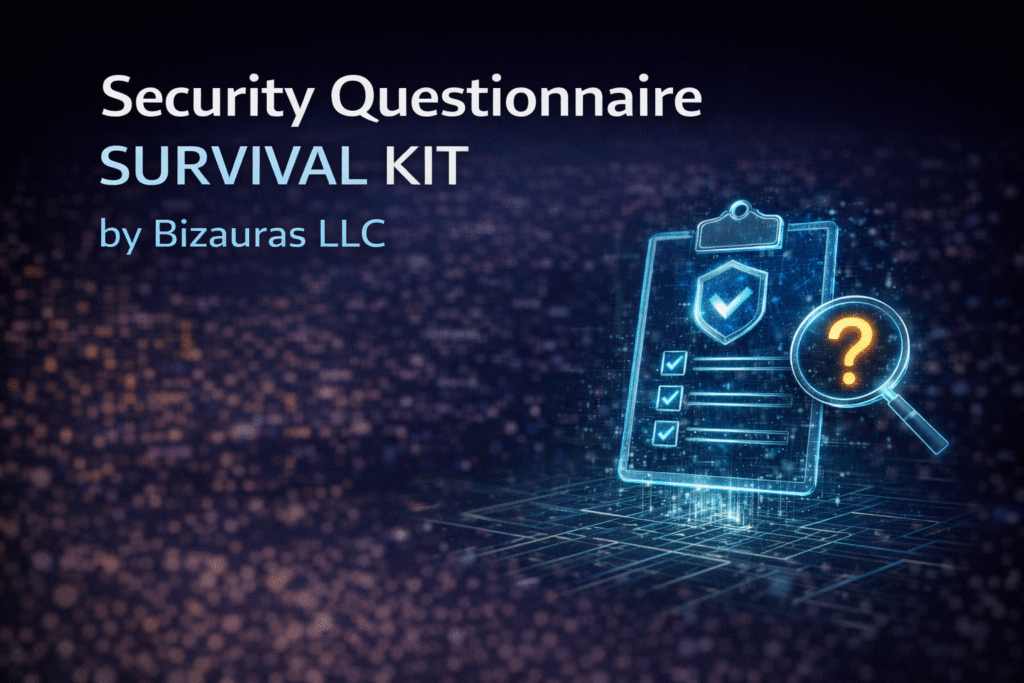
Security Questionnaire Survival Kit
Close Enterprise Deals Faster with Pre-Built Templates and Practical Guidance
We sat on both sides of the security questionnaire table, helping early-stage SaaS teams respond while watching enterprise buyers quietly walk away from promising products.
The reality is this: your demo might spark excitement, but a weak or slow security response often becomes the silent deal-killer. That’s exactly why we created this Survival Kit: to turn a painful compliance exercise into a clear signal of operational maturity and trustworthiness.
Why Security Questionnaires Matter More Than You Think
Enterprise buyers evaluate far more than features and pricing. They’re assessing whether your operations are reliable enough to protect their most sensitive data.
- The average SaaS deal faces 2–3 weeks of delays due to security questionnaires.
- Many teams have lost deals worth $50k–$500k simply because answers felt inconsistent or unprepared.
When handled well, your responses become a powerful sales tool that builds confidence rather than friction.
Common Pitfalls and How to Fix Them
Here are the most frequent mistakes we see in growing SaaS companies and the simple changes that make a big difference:
| Pitfall | What It Signals to Buyers | Actionable Fix |
| No clear ownership of answers | Chaos and lack of accountability | Assign a single owner for each category (e.g., Audit Logs → Security Lead) |
| Undefined internal processes | Lack of operational maturity | Document processes clearly, including tools and review frequency |
| Delayed responses | Operational friction | Use a shared living document with firm deadlines |
| Inconsistent terminology | Confusion and elevated risk perception | Standardize key terms across all materials (“RBAC”, “MFA”, “incident response plan”) |
| Overcomplicating answers | Difficulty building trust | Keep responses short, factual, and specific to your tools |
These small improvements can dramatically reduce back-and-forth and help deals move faster.
How Enterprise Buyers Really Evaluate Your Responses
| Evaluation Factor | Weak Answer Example | Strong Answer Example |
| Consistency | “Yes, we have audit logs” | “Audit logs are captured in Data dog across all environments, retained for 12 months, and reviewed weekly by our Security Lead.” |
| Ownership | “Handled by the team” | “Owned by our Security Lead, with quarterly reviews by the Engineering Lead.” |
| Maturity | “We usually monitor incidents manually” | “Incidents are detected automatically via Pager Duty and managed through a documented incident response plan with defined SLAs.” |
| Timeliness | “We respond as we can” | “We commit to completing questionnaires within 3 business days.” |
| Transparency | “Everything is secure” | “We follow ISO 27001 controls; any identified gaps are tracked in an active remediation plan.” |
Buyers read between the lines. Clear, confident, and consistent answers speak volumes about your team’s readiness.
Structured Answer Framework (Ready to Adapt for Your SaaS Environment)
| Question Type | Example Question | Suggested Answer Template |
| Tenant Isolation | How do you separate customer data? | We use logical tenant isolation with dedicated database schemas and namespaces in our Kubernetes-based infrastructure. Access is strictly enforced via RBAC and Okta . Quarterly reviews are performed by our Security Lead and Infrastructure Engineer. |
| Audit Logs | Do you maintain logs? | All critical systems and application events are logged to Data dog. Logs are retained for 12 months with immutable storage. Weekly reviews are conducted by our Security Lead, with alerts routed to the Engineering team. |
| Incident Response | What is your incident response process? | Incidents are detected automatically via Pager Duty and monitoring tools. The on-call Engineering Lead is notified immediately, customers are informed within our SLA (usually 24 hours for high-severity), and we conduct a blameless post-mortem documented in Notion. |
| Access Management | How is access controlled? | We enforce least-privilege access using RBAC in our cloud environments, with mandatory MFA via Okta or Auth0. Onboarding/offboarding is automated through our HRIS and SSO workflow. Access reviews are performed quarterly by the Security Lead and Engineering Lead. |
| Data Backup | How is data backed up? | Customer data is backed up daily with automated snapshots to geo-redundant AWS S3 buckets. Backups are encrypted in transit and at rest. Recovery is tested quarterly by the Infrastructure Engineer, with documented RTO/RPO targets. |
Tip: Replace the tools and cadences with your actual SaaS stack (e.g., AWS/GCP, Datadog, Sentry, Linear, Notion, etc.). For early-stage teams, it’s perfectly fine to note “managed by our small engineering team”. Honesty builds more trust than pretending to have a large dedicated security function.
Quick Wins You Can Implement Today
- Create one centralized internal document (Google Doc or Notion) with all your questionnaire answers.
- Assign clear owners using your real SaaS roles (Security Lead, Engineering Lead, Infrastructure Engineer, etc.).
- Set a realistic response deadline e.g . within 3 business days.
- Standardize terminology across sales, security, and product materials.
- Treat this as a living template and review it quarterly or after any major product or infrastructure change.
- Run a quick dry-run using your top 10 most common enterprise questions to spot gaps early.
Internal Tracking Mini-Checklist (Tailored for SaaS Teams)
| Question Category | Owner | Last Updated | Status |
| Tenant Isolation | Security Lead | 09-Apr-2026 | ✅ Completed |
| Audit Logs | Security Lead | 09-Apr-2026 | ✅ Completed |
| Incident Response | Engineering Lead | 09-Apr-2026 | ✅ Completed |
| Access Management | Security Lead + Infrastructure Engineer | 09-Apr-2026 | ✅ Completed |
| Data Backup | Infrastructure Engineer | 09-Apr-2026 | ✅ Completed |
Use this as your real-time tracker and update it whenever your SaaS processes or tools evolve.
A Real-World Example
One mid-stage SaaS team we worked with had a promising $380k ARR deal stuck for three full weeks on a lengthy 200-question security questionnaire. The buyer kept coming back with follow-ups because responses felt inconsistent and ownership was unclear.We built a centralized answer kit using frameworks like the ones above, assigned owners based on their actual roles (Security Lead and Engineering Lead), and standardized language around their real stack (Datadog, PagerDuty, AWS). The very next questionnaire was completed in just two days. The buyer responded: “This is one of the cleanest and most professional responses we’ve received.
The deal closed shortly after turning what had been a major blocker into a genuine trust-builder.
Next Steps for Your Team
You don’t need a large security team or perfect policies overnight. You just need a practical, living system that reflects the maturity of your growing SaaS operations.
Start by implementing these simple frameworks and watch how quickly your security responses stop slowing you down and start helping you close faster.
Bizauras is offering a free 15–20 minute strategy call with our team. On this call, we’ll:
● Take a quick look at how you’re currently handling security questionnaires and enterprise readiness
● Point out the gaps that are usually slowing down deal approvals
● Share simple, practical ways to structure your answers so enterprise buyers get what they need faster
Schedule your free session here
Schedule your free session here → https://calendly.com/bizauras/15min?month=2026-04
You’ve built something worth trusting. Let’s make sure your security responses reflect that.